The Dolomites Might Be the Best Driving Vacation on Earth
After driving roads across four continents, a week on the Sella Ronda, Passo Giau, and the high passes of the Dolomites reset my standard — and cost me a set of front tires.
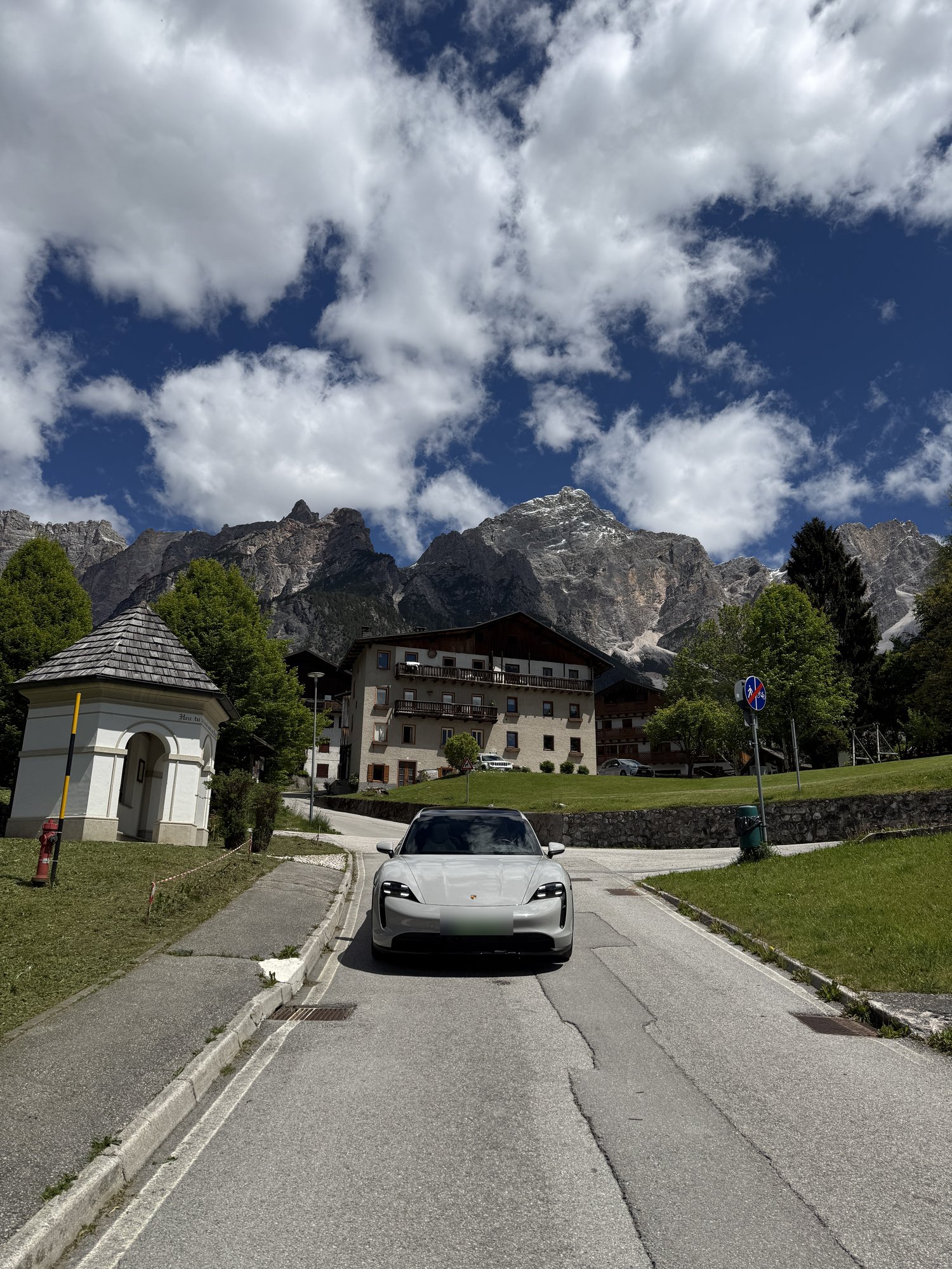
I’ve been lucky enough to drive in a lot of places. Coastal Australia. New Zealand’s South Island. Texas Hill Country. Tuscany, more than once. When you’ve done that much of it, something unfortunate happens: it gets harder to be impressed. You start comparing everything to everything else, and most places land somewhere in the middle of the list.
The Dolomites didn’t land in the middle of the list. The Dolomites broke the list.
I spent a stretch of summer 2026 driving the passes of northern Italy in my Taycan Cross Turismo — the same car that started this whole chapter of my life — and I’ve been trying to articulate what happened up there ever since. This is my attempt.
The route
We based ourselves in two towns and I’d recommend both without hesitation. Cortina d’Ampezzo first — fresh off hosting the Winter Olympics, and every bit the alpine capital you’d expect, with the Tofane peaks hanging over town. Then Auronzo di Cadore, quieter, sitting on a turquoise lake further east, and a perfect launch point for the eastern passes.
From those two bases we drove the roads that make this region famous:
The Sella Ronda — the loop of four passes around the Sella massif, including Passo Pordoi and Passo Gardena. You can run the whole circuit in a morning, then turn around and run it the other direction after lunch, and it feels like a completely different road.
Passo Falzarego — the road out of Cortina toward the Lagazuoi cable car, and the pass that gave us our favorite coffee stop of the whole trip.
Passo Giau — the one I’d tell you not to miss if you only had one day. Twenty-nine hairpins on the Cortina side, and at the summit the Ra Gusela rock face rises straight out of a green meadow like it was placed there for photographs.
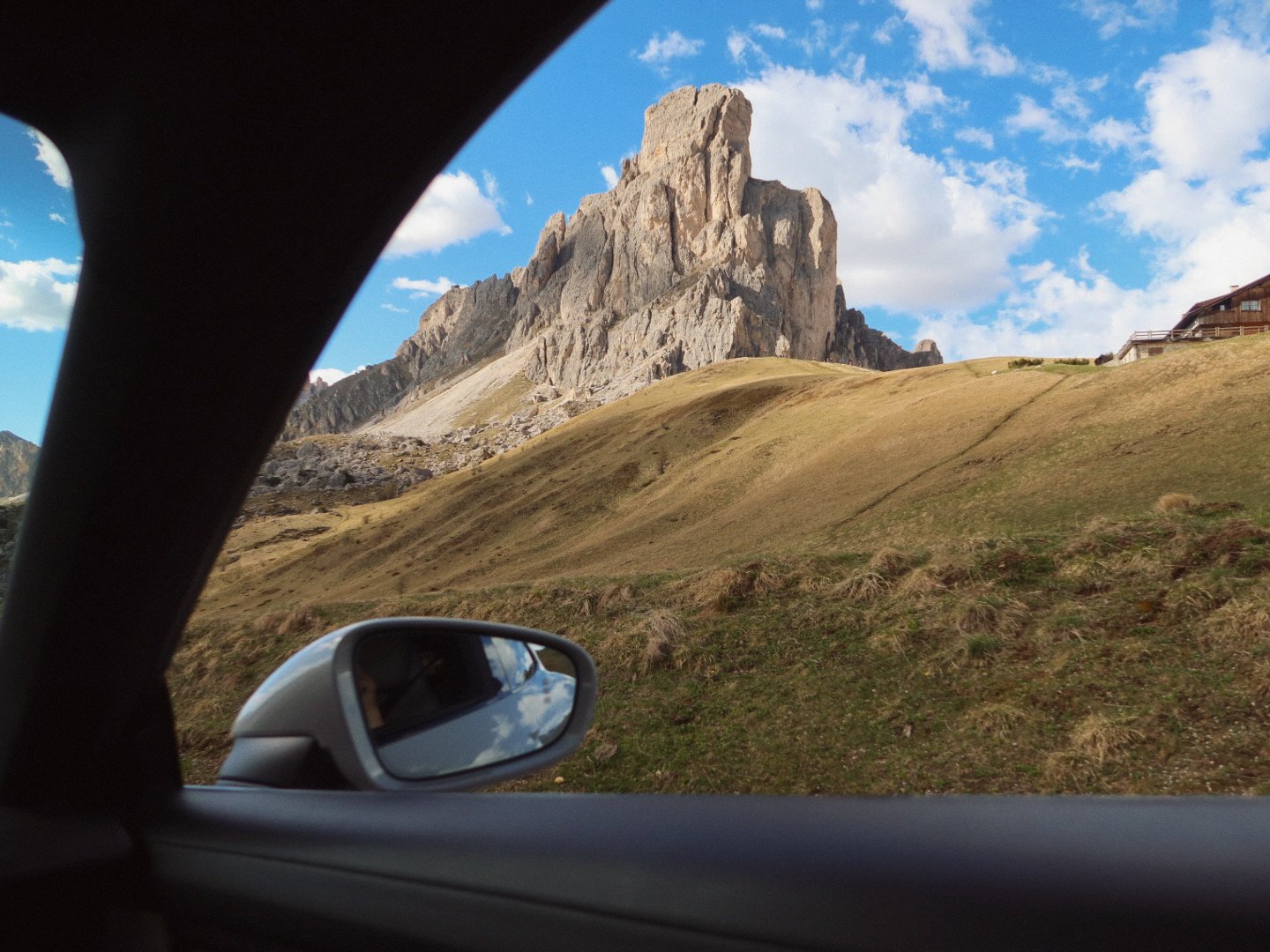
And because we couldn’t help ourselves, we ran west beyond the Dolomites proper to Passo Gavia — narrower, wilder, single-lane in places, and worth every kilometer of the detour.
Roads that feel designed for drivers
Here’s the thing that struck me first, before the views, before the food: the roads themselves feel intentional. Every hairpin is cambered the way you’d want it. Sightlines open exactly when you need them to. Straights are long enough to breathe but short enough that you’re never bored. It’s almost as if the engineers who built these passes were enthusiasts themselves — and given how many of them you’ll share the road with, maybe they were.
And I genuinely believe this: even if you’re not a car person, a week in the Dolomites would send you home shopping for a sports car. The roads make the argument for you.
The road quality nobody talks about
This is the detail that separates the Dolomites from almost everywhere else I’ve driven, and I only noticed it because I’d come from Tuscany.
I love Tuscany. It’s one of my favorite driving regions in the world — the cypress-lined roads, the golden hills, all of it. But the pavement there is honest countryside pavement: patched, uneven in places, crumbling at the edges. You drive Tuscany at eight-tenths because the surface asks you to.
The Dolomites are different. The tarmac on the major passes is close to perfect — smooth, well-marked, consistently maintained. And that changes everything, because it means you can actually use the car. You can lean on the front end into one of Giau’s hairpins and trust what comes back through the wheel. You can push toward the limit instead of tiptoeing around it.
I may have taken that permission slightly too literally. I came home needing a new set of front tires. Zero regrets. That feeling — a proper car, a proper road, and nothing between you and the drive — was something I’d never fully experienced before, and I’d cross the world to feel it again.
The culture up in the passes
The driving is only half of it. What makes the Dolomites feel complete is everything wrapped around the driving.
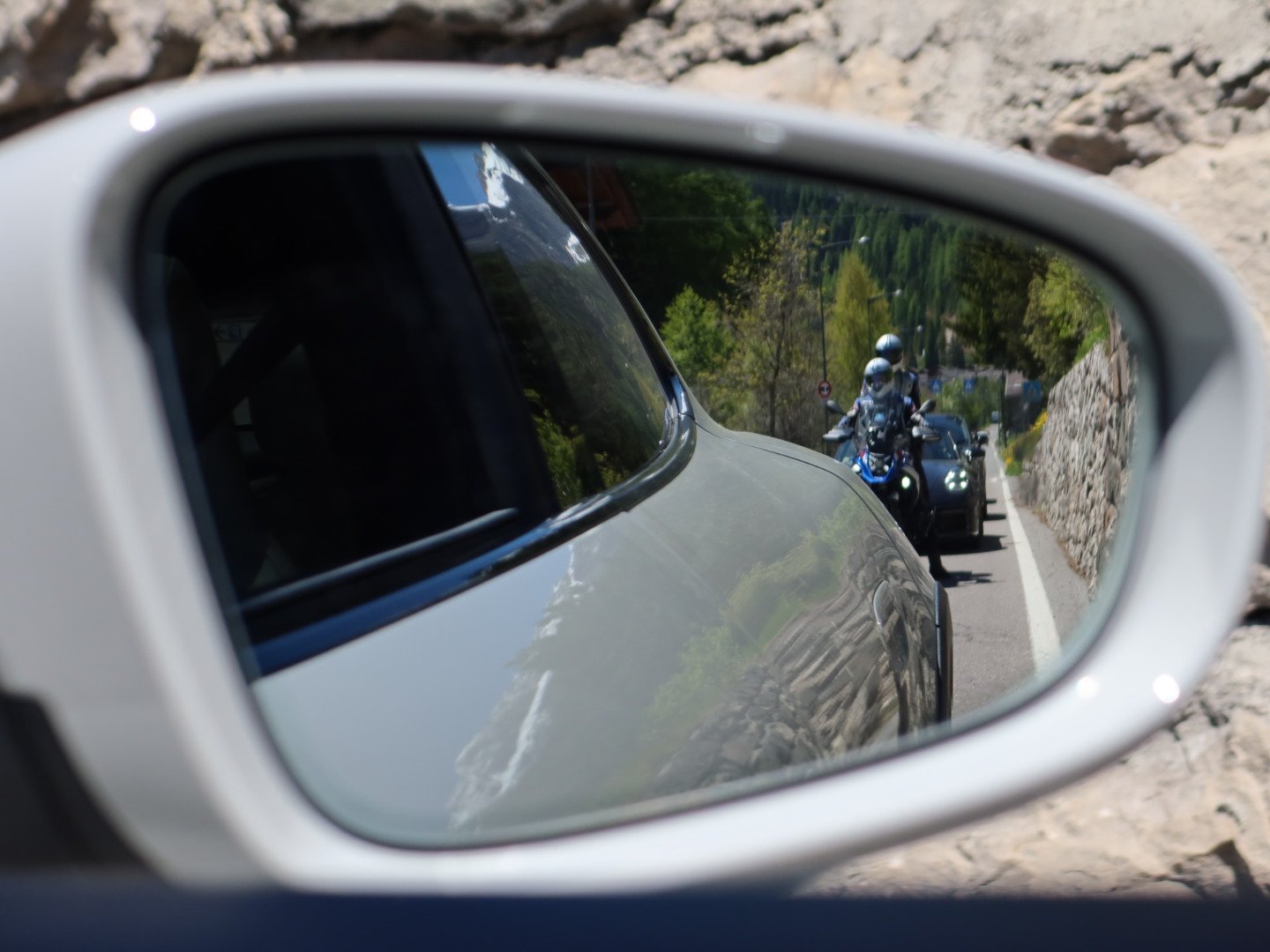
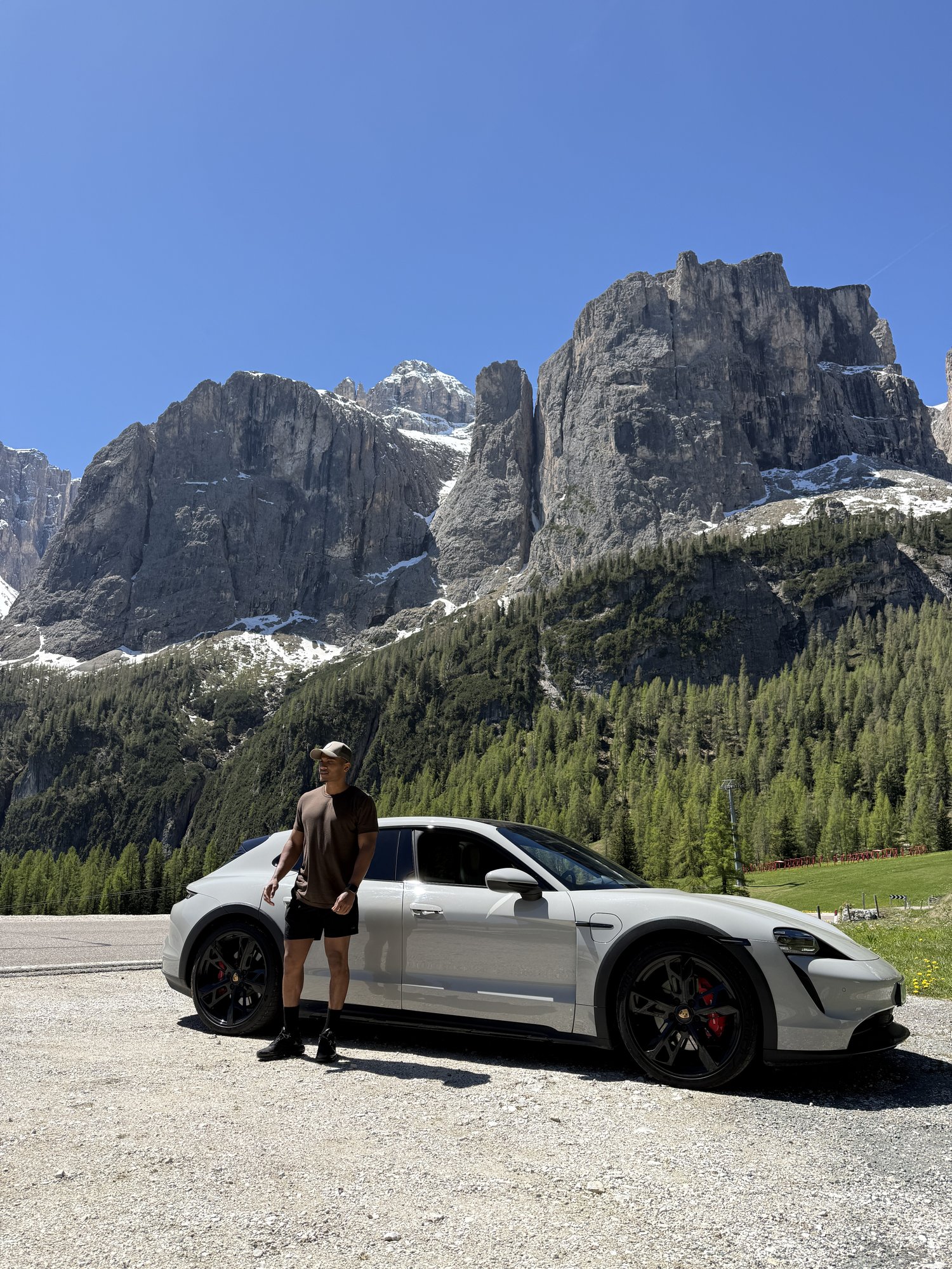
The pull-over spots. The passes are dotted with laybys and viewpoints that seem positioned by someone who knew exactly where you’d want to stop — limestone towers behind you, valley floor far below, your car parked in front of it like the whole scene was staged. I’ve never taken so many photos of a car in my life.
The mid-day stops. Rifugios and mountain restaurants sit right on the pass roads, nearly all with a terrace and a view that would be the highlight of most vacations. Two I’d send you to without hesitation: Ristorante Rifugio Ospitale, a genuinely old inn on the road to Dobbiaco that’s been feeding travelers since the 1100s, and Rifugio Ospitale’s alpine cousin up at altitude, the terrace at Lagazuoi. Lunch at altitude, bikers and drivers trading stories at the next table, then back into the car for the afternoon passes.
The coffee. Italian mountain cafés, espresso that costs a fraction of what it should given the setting. The Lagazuoi Terrace Bar, perched at 2,732 meters at the top of the Lagazuoi cable car off Passo Falzarego, became a ritual — coffee and pastries from Cortina’s Alverà bakery with the entire eastern Dolomites laid out below the terrace.
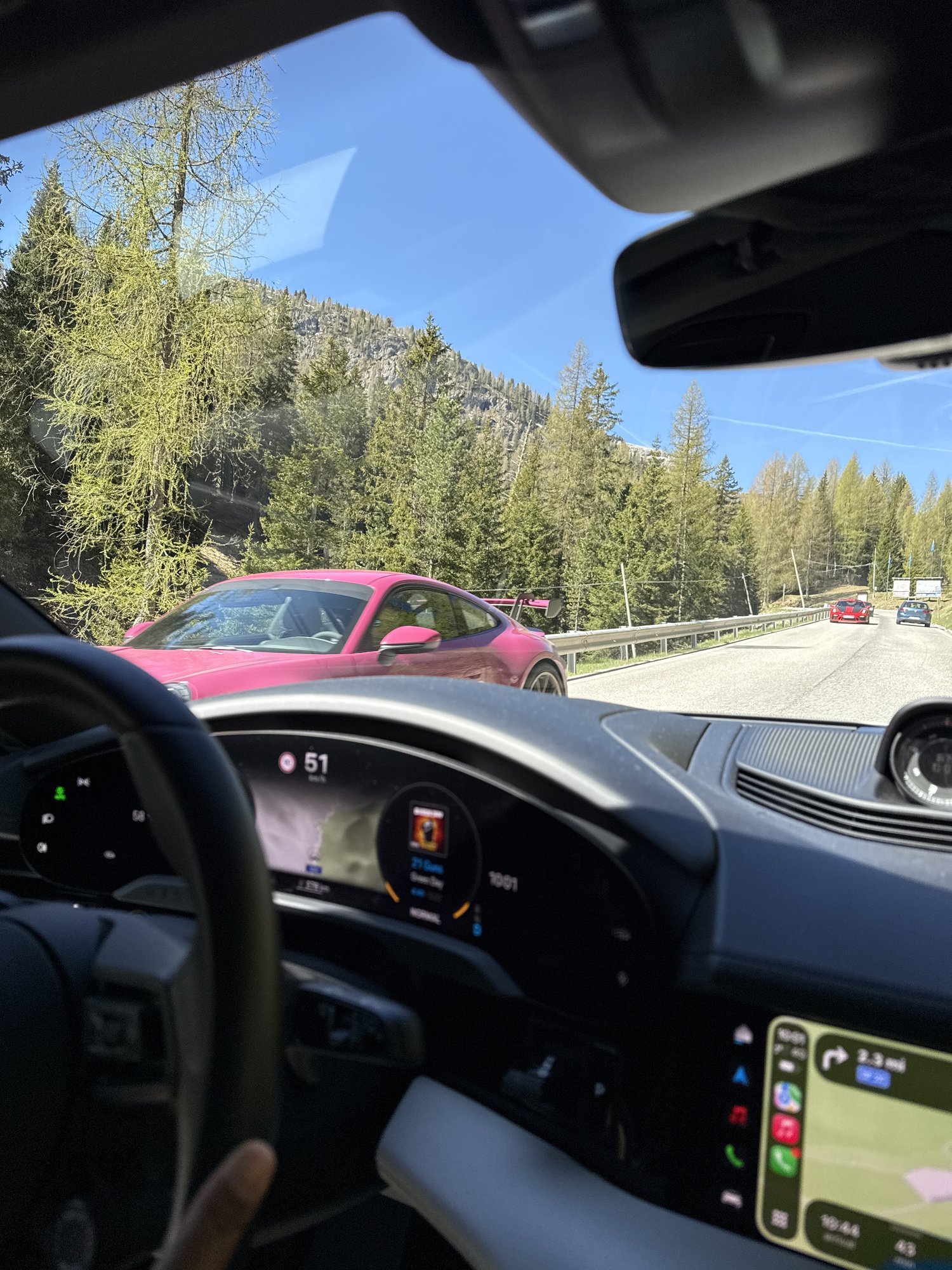
And the community. If you’re driving anything interesting — and up there, most people are — expect headlight flashes and nods all day. At one point a pink 911 GT3 rolled past us near the top of a pass, wing and all, and the driver gave us the kind of wave that says you get it. As a Porsche owner I’ll admit some bias, but the flash-and-wave culture in these passes is something I haven’t experienced at that density anywhere else in the world.
When to go
Summer, full stop. Most of the high passes close under snow for a large part of the year — depending on the pass, closures often run from late autumn into late spring. The window when everything is open, dry, and grippy is roughly June through September. Early September is a sweet spot: warm tarmac, thinner crowds. In early summer you’ll still catch snow on the peaks while driving in a t-shirt, which is its own kind of magic.
What to drive
I did it in a Porsche, and I don’t think I’d choose anything else. The Dolomites reward a car with communicative steering, strong brakes, and enough composure to stay flat over crests — which is basically a description of everything Porsche builds. The Taycan Cross Turismo turned out to be a near-perfect tool for it: instant torque out of hairpins, no altitude penalty, and silence at the summit so the only soundtrack is wind and cowbells.
That said, the roads are so good that almost anything engaging would shine here. It’s less about horsepower and more about connection. This is not a place for a numb car.
Who the Dolomites are for
The best comparison I can make is Aspen — but for drivers. That same blend of genuine adventure and quiet luxury: mornings that get your heart rate up, evenings with a good glass of wine and a mountain view. If your ideal vacation mixes an active lifestyle, spectacular scenery, and real driving, I don’t know of a better combination anywhere.
I’ve been fortunate to see a lot of the world, and it takes a lot to genuinely surprise me now. The Dolomites didn’t just surprise me — they reset my standard for what a driving vacation can be. Some things you can’t fully explain in writing. This is one of them. You have to go feel it through the steering wheel yourself.
I’m the founder of Seren Mont, where we design private self-drive journeys on roads like these — route, car, hotels, all arranged before you arrive. Our Dolomites journey is built on the exact passes from this trip.